City Kitchens Anniversary Sale
27-Aug-2008
For those of you in Seattle and surrounding areas…. City Kitchens Anniversary Sale has started and runs until the end of September. Everything in the store is at least 10% off and many things are marked down more than that. This is a great time to pick up those odds and ends that never seem to go on sale. Last year I picked up great steak knives that were 50% off, among other things.
City Kitchens
1527 4th Ave (just south of Pine)
Seattle
Seattle
206.382.1138
Preserving
25-Aug-2008

Of all the things that were passed down to me by my parents, grandparents, and aunts one of my favorite things is the art of preserving. It’s just so useful! But even more than being useful, when I’m in the middle of making jam or pickles or applesauce I feel a sense of connection to all who have come before me. Whether they preserved foods to capture the bounty from their gardens or from a sense of thrift or as a way to survive the winter months, the art of preservation continues to run strong. I know that while I’m in my kitchen working with some fruit or vegetable there’s a good chance that at the exact same time my Dad or my sister is in their kitchen doing something similar.

I don’t do as much of it as I once did – mainly because I can’t always eat it all before the next year’s crop arrives. But this weekend I spent a day making peach jam and a nice batch of applesauce. Canning is like riding a bike for me. Each year as I start my movements are a little slow but within a few minutes I’m back into the rhythm of whatever needs to be done for the job at hand. Blanching, peeling, slicing, smashing, cooking, mixing and finally filling the jars are all part of the zen. And I really do enter a very meditative state. My movements flow and although I concentrate on the task at hand it’s with a flowing ease, with one step leading to the next. The repetitive motion is addictive and soothing. It’s a dance that can be performed by one or a group.

And the best part is that when you are finished you have something beautiful, delicious, good for you, and that will bring back a little taste of summer in the middle of a cold winter day.

Think Pink!
24-Aug-2008

We’ve had such an up and down summer here in Seattle that it’s been a bit hard to get the real feel of the long, lazy dog-days of summer. And that has made it twice as important to take advantage of the good days when all the elements – sun, heat and a bit of free time – come together in the perfect convergence.
Several weeks ago my friends MG and DW slipped a bottle of rosé on the backseat of my car sometime while I was at their house. Such a great surprise when I found it! This wasn’t just any rosé but one they’d been telling me about, produced by Grochau Cellars (GC). (Full disclosure time… MG’s brother and sister-in-law own GC and make the wine.) Once I’d found the wine it went directly into my fridge to be chilled and ready to go at a moment’s notice.
The perfect time finally arrived about a week and a half ago. I had nothing on the agenda, the sun was out, it was perfectly warm with just a little breeze coming in from Puget Sound, and the lawn could really wait another day or two to be mowed… So I opened my treasured bottle and settled myself on the deck, cats at my feet and a glass of gorgeous rose-colored rosé in my hand.
The wine is called Pink and it’s a rosé of Pinot Noir. As mentioned, and you can see in the photo above, the color is a pretty intense rose with just the slightest copper nuances. The nose is most definitely strawberry – wild, mountain strawberry. The kind you have to hunt to find but once you do, the intense flavor makes the search worthwhile. With that big hit of strawberry I was a bit worried the wine might be a bit sweet. Silly me. This wine is delightfully crisp. The flavor is not as much strawberry as the nose is. There is some but maybe a little tart cherry, too. It seemed that as the wine warmed a little it actually had hints of pink grapefruit – very nice.
As it leaves the palate there is just a hint of flavor remaining. It doesn’t linger long, but that’s okay. Like the warm summer days the best rosé is often fleeting – meant to be drunk young (you can be any age but the wine is best young!), and a refreshing thirst-quenching respite from the heat. And that heat could come from the sun or from something spicy and this wine would be nice with both.
I’m not sure how available this is this year. (Sorry!) I think you can find it some places in Oregon since GC is based in the Willamette Valley, but I bet there will be more next year. So make a note of it and keep your eyes open next spring.
Wine Blending @ El Gaucho
20-Aug-2008

Monday night I participated in a new type of event being offered at El Gaucho in Seattle. In my quest to learn more about wine I attended a "Wine Components" class. As we arrived we were presented with a glass of sparkling wine and had access to light appetizers. Most people moved directly to a place at a table, some taking time to mingle first. After 15 or 20 minutes of settling in the program began.
The program was produced by team of players: El Gaucho, of course; Spring Valley Vineyard, which is actually managed and owned by Ste. Michelle; Ste. Michelle; and Esquin Wine Merchants.

The winemaker from Spring Valley Winery, Serge Laville, brought in four single varietal wines (the components) that are used in some of their blends. He gave us some background on what a winemaker thinks about and looks for when blending wines, we tasted through the components, and then we started producing our own blends. Each place setting had four varietals: Merlot, Cabernet Franc, Petit Verdot, and Malbec. All were Spring Valley’s 2007 wines. We also had a plastic pipette, marked in 1 mm increments, to use for measuring and blending the wines.

I was sitting with a great group of people. Across from me were two principals from a new winery, Watermark Cellar (not yet on the market); next to me was Arnie Millan from Esquin; and next to Arnie was the Spring Valley winemaker, Serge. So besides the formal presentation there was a lot of interesting table talk.

We all began sniffing and tasting, measuring and mixing, working to get the flavor, structure and complexity we preferred. It was interesting to see what different people came up with. I can’t say that I created anything extraordinary but I sure had fun trying! And it was informative to see what other people did and how they approached the exercise. My feeling that wine-making is much like cooking was reinforced. With experience you can imagine how different foods will taste when blended or presented together. When you cook you make slight adjustments based on the specific properties of the foods being used that day. For instance, herbs vary in intensity based on what time of year they were picked, how much rain there has been and maybe even the place they were grown. So you need to take that into account and balance the actual flavor with the sort of flavor profile that is in your head.

Wine blending follows similar principals. If you use grapes from the same vineyards each year I think the winemaker will end up with a basic understanding about each varietal from specific vineyards but, as we all know, there can be wide swings in what you actually end up with based on weather and other factors. I think many people think that wine-making is a challenge but really wine blending is where the skill of a winemaker becomes known as they balance the wines each year based on the nuances that are indicative of that growing season.

At other points during the evening Serge talked about topics such as the challenge of using the components to get the desired taste profile, yet having to balance that with the amounts of each wine available for blending. For instance of the varietals we were working with the winery had different amounts to draw from when blending, there were 100 barrels of Merlot available but only 6 or 7 barrels of the Petit Verdot and Malbec. He talked about how wine-making really begins in the vineyard with the setup and location of the vineyard, how you treat the grapes, and when you pick them. I believe Serge’s view was that 80% of wine-making actually takes place in the vineyard. He also talked about their blending process, the timeline and the players involved in Spring Valley’s process.
After we had the chance to create a few different blends, Serge asked the group some questions and talked to the different tables. We finished the evening by enjoying two of Spring Valley’s wines, Frederick and Uriah and had a chance to order (at a discount) Spring Valley Vineyard wines from Esquin.
It was a very enjoyable and informative evening. I’ve signed up for the next event on September 18th. That night, Northstar, another Ste. Michelle property will be presenting. I’ll see if I can apply what I learned on Monday along with whatever new nuggets I learn that night. Maybe my blending skills will improve! Or not.

Colony Collapse Disorder
19-Aug-2008

I’ve been holding back on writing this post but have finally decided to go ahead with it despite my reservations. We’ll get to those in a moment.
I’m sure most of you are aware that the honeybees are dying or disappearing and we don’t really know why. This phenomenon has been named Colony Collapse Disorder (CCD) and really nothing is known about it except that it happens. Research is going on at a few universities to try to figure out what’s causing it and if we can stop it.
I have a special fondness for bees, not just because the are an important part of our food chain, but because I love hearing them buzzing around my yard. I’m not so interested in yellow jackets and wasps – although they have jobs, too – but in the honeybees and bumble bees that spend time pollinating my summer crops and flowers. There’s just something about them I find soothing. And I would be incredibly sad to lose them even if we somehow found another way to pollinate crops.
About a month ago I received an email from Häagen-Dazs about a new awareness campaign they’ve created to help bring the plight of the honeybees to our attention. They’ve created a video, a site and a donation program to help with research. And this is where my reservations kick in.
The site is one of those maddeningly cute sites that take forever to negotiate. There is some useful information on it, but I would think most people would bail out before actually finding it. Still, if you can stick with it there are suggestions on how everyone can help out, among other things. Also, they have developed a special flavored ice-cream called Vanilla Honeybee. When you buy it or several other flavors they will make a donation to one of two research programs. The problem is that they don’t tell you how much they will donate. Still something is better than nothing, I guess. However, perhaps you would be better off just donating the entire price you’d pay for the ice-cream to one of the research programs, you know?
So, I’ve decided to write this post to help draw attention to the issue, even if Häagen-Dazs methods for educating people leave something to be desired. At least they are doing something and that is good.
The photo at the beginning of this post was taken at UBC at the Outstanding in the Field dinner I recently attended there. To date, they have not been affected by CCD. Yay! They have several honeybee hives on their farm and as you can see in this photo a thriving colony has returned home for the evening. The photos at the bottom of the post were taken in my garden. Bumble bees are also important pollinators. So far this issue does not seem to be affecting them, or maybe we just have not yet realized it. I have had periods of time when I’ve found several dead bumblebees on my plants. I don’t ever spray but my guess is that someone in my neighborhood is using some sort of pest control that affects them. This makes me so sad. The video in the center was created by Häagen-Dazs to help raise awareness. Here’s what they say about it: "When a honey bee returns to the hive after finding a good source of nectar, it will perform a unique dance for its hive mates, detailing the distance, direction, quality and quantity of the new food supply. The richer the food source, the longer and more vigorous the dance. This is our Hip-Hop interpretation of that dance".
And here’s the link to their site where you can learn more: Help The Honeybees


Voxx Coffee
18-Aug-2008

I have a home office and am always looking for good public places for business meetings. I don’t have too many prerequisites other than the place should be conducive to conversation: both quiet enough so you can have one and a decent seating setup so you have a little privacy. It shouldn’t be messy – nothing worse than getting crumbs or coffee stains all over your laptop or business papers. And free WiFi is always good, too.
This morning I had a meeting at Voxx Coffee on Eastlake. I love the feel of the place. The layout is good and the furniture is handsome, yet functional; they have free WiFi and serve Stumptown coffee, as well as a small but good selection of tea. The pastries and sandwiches looked good although I didn’t try them, and in the evenings they serve wine.
There’s enough patron traffic that it imparts a bit of energy, yet there was plenty of seating. The WiFi was not working when I arrived and the baristas did not have access to the router. Eventually a manager or someone showed up and was able to reboot it and get it working. It’s a pleasant place overall even with the little glitches. My only issue was that there are lots of hard surfaces and so the noise seems louder than it should be. Not great for a business conversation but fine for meeting friends or for getting out of the house to work amongst other humans.
Voxx Coffee
2245 Eastlake Ave E
Seattle
Seattle

When life gives you apples…
17-Aug-2008

My apple tree has been throwing apples at me for the last week or so. It’s not being mean but it’s branches are too crowded. I didn’t think I was going to get too many apples this year so I didn’t thin them. But there are actually quite a few so some are getting pushed off the branches to make room for the others to continue growing. Unfortunately this crowding leads to smaller apples; more of them but lots smaller. But I’m really not good about thinning them anyway. I really hate to "kill" anything that’s beat the odds and growing. Especially this year with the horrible early summer weather we had.
So, the point of all this is that I am accumulating lots of smaller windfalls. And the best thing to do with those is make applesauce. I made a small batch tonight. Applesauce is one of the easiest things to make. You just slice apples into quarters (or maybe smaller pieces if the apples are large) without bothering to peel or core them; put them in a pot with a little water and cook over medium-low to low heat until the apples are soft and a little mushy; run them through a chinoise & pestle set or food mill
 to separate the sauce from the peels; add a little sugar to suit your taste; and eat it! "Leftovers" can be kept in the refrigerator or if you make a big batch you might want to can some to have for the winter.
or food millto separate the sauce from the peels; add a little sugar to suit your taste; and eat it! "Leftovers" can be kept in the refrigerator or if you make a big batch you might want to can some to have for the winter. 
First Look: Spur
15-Aug-2008

Seattle’s newest gastropub, Spur, has been open just about a month now. Located in the space previously occupied by Mistral, the updated interior serves up a variety of seating options with something for everyone. There are several seats along the bar; a couple of long, tall tables perfect for groups or for communal dining; and a little section of more traditional four-tops. Everything is wood with a rough-hewn look, if not texture, but I guess you might expect that in place called Spur. While very handsome and comfortable on a warm Seattle evening, I think this space will be super cozy and inviting as we head into the rainy months. But let’s not get there, yet!
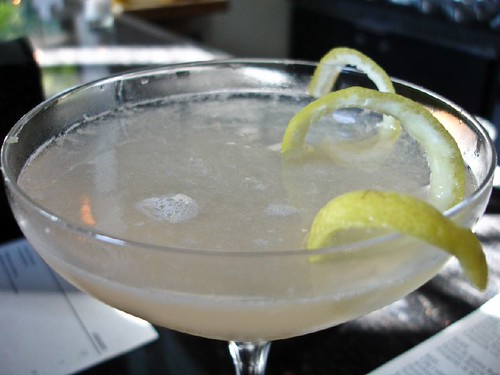
The specialty drink menu is enticing and interesting with many of the ingredients created in-house. R started with the Sur le Sol, a beautiful concoction including vodka, St Germain, lavender and more. It was maybe a tiny bit sweeter than she would have preferred but the overall flavor was nice.
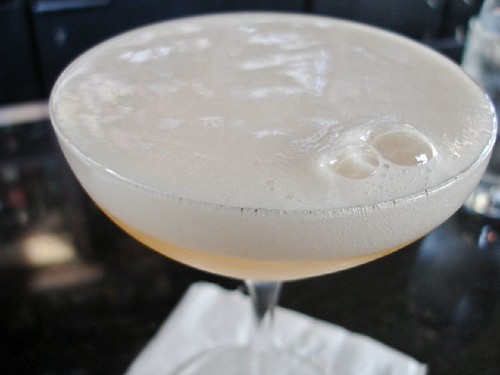
I had an Empress made with rum, St Germain and grapefruit, topped with a gorgeous grapefruit and orange foam. Loved it! Along with our cocktails a little jar of house-made corn nuts arrived. They were crispy, salty and fried – the perfect item to nibble on with a cocktail.

We started our meal with the Summer Vegetable Salad, a colorful mix of summer squash, carrots, tomato and nasturtium with buttons of corn panna cotta placed carefully around the plate. The panna cotta can be eaten as a little softly exploding bite or popped on the plate and mixed into the dressing. I tried to do one as a bite but alas was unsuccessful as it popped midway between plate and mouth.

Next, after much debate – so many items on the menu sound very good, we settled on the skirt steak. The skirt steak was grilled exactly to our medium-rare specification and was delicious! Succulent and a bit smoky, it melted in your mouth. The shallot jam that accompanied was also very good – I could have eaten it by the spoonful. Neither of us were thrilled with the fried mashed potatoes that were also on the plate. The interior of the patty was almost paste-like in it’s smoothness. There was really no texture at all and the frying seemed to have been done just because. No real reason except, I guess, to make the potatoes different. They actually tasted good but the texture left me wanting. To their credit when we gave this feedback to the hostess she reported back to the kitchen so the chefs could check it out and make adjustments, if needed. It was a warm night and the potatoes are loaded with butter so perhaps that was the issue.

Somewhere in there we switched out our cocktails for a couple glasses of wine. The by-the-glass menu is short but seems to cover most bases. I was surprised though that there was not one single local red wine by the glass. For a restaurant that is professing a love for local and sustainable ingredients on the food menu, this seems like an oversight.

We finished our meal with a cheese plate comprised of three Estrella Family Creamery cheeses and some accompanying garnishes. The crackers were great; you probably already know that I love Estrella cheese; and the accompaniments were… interesting. Not interesting bad, really just a bit too precious in their tiny-ness. And this was especially obvious because the wedges of cheese were quite nicely sized so all the additional garnishes ran out long before the cheese. Especially disappointing were the "peach balls". The menu indicated there were peaches on the platter and at this time of year with fragrant, sweet, ripe, juice-running down-your-chin peaches in abundance, our mouths were set to enjoy some of that goodness. Instead our platter arrived with six of the smallest, cutest little peach balls. Probably only about 1/2" in diameter the six of them together barely made a bite. The other items on the plate followed suit in their petite-ness but it was the peaches that were particularly disappointing.
Prices are not unreasonable but it does seem like some of the cost might be due to the labor needed to create all those teeny-tiny little garnishes. Having said all that, I do look forward to returning as the flavors are very good and the menu items were creative. I may just spend a little more time clarifying with my server exactly what it is I will or will not be getting when I order.
Spur Gastropub
113 Blanchard St.
Belltown
Seattle
206.728.6706

Outstanding in the Field Redux
12-Aug-2008

After my first experience with an Outstanding in the Field (OITF) dinner I was left with a little nagging feeling. I wasn’t entirely sure why but I thought it was probably because I had hoped that the experience and information from the farmers and other producers would be a little bit richer. While writing that first post I noticed that the dinner in Vancouver, BC at the UBC farm had not sold out. And I knew that this was the 4th year a dinner would be held at UBC, leading me to believe the experience there might be well-organized and more comprehensive than my first experience. Before I knew it I found myself reserving a spot at that dinner, canceling my other plans for the evening and planning a one-day, less-than-24 hour getaway to Vancouver – technically not even long enough to bring goods back over the border!

Friday morning as I crossed the border rain showers were drifting in and out. I first made a stop in White Rock and spent the morning there enjoying walking on the beach, watching the activity as the residents prepared for a weekend festival and eventually grabbing lunch. As I made my way into Vancouver proper and Queen Elizabeth Park, where I’d planned to take some photos, the rain came down in earnest and instead of shooting the Vancouver skyline from the park I took a nap in my car.
But after that downpour the weather seemed to take a turn for the better. The skies remained gray but were dry.

I took a meandering route along English Bay and Burrard Inlet, stopping at beaches along the way, and arrived at the UBC Farm at the appointed start time of 6:00 pm. The farm sits just southwest of the main campus and is comprised of 60 acres about half of which are wooded and the other half cleared and used for crop production. The farm serves a variety of purposes (as explained by Mark Bomford, the farm manager who led my part of the farm tour later in the evening) and is used for more than just the agricultural program, for instance it also supports botany classes.

After parking I walked down a path and across a field to the welcome table to grab a glass of wine. While sipping wine big platters of fresh radishes, carrots and peas were available for nibbling. I spent some time roaming around the nearby grounds checking out various crops, some greenhouses, beehives and the free-range chickens. At some point I met a woman who’s area of speciality was anthropology and her studies and teachings revolved around food. She’d spent three years teaching in Italy and was very into the slow-food movement. She was at the dinner having been invited by two former students who now work for OITF. I really enjoyed talking with her.

Soon after the field tours began. First Jim Denevan, OITF founder, addressed the group and then we were split into four groups for the tour. As mentioned earlier my group was lead by Mark Bomford who had a great depth of knowledge about the farm and issues facing the agricultural community. One little note – he said they have not experienced Colony Collapse Disorder which has been affecting so many beekeepers and their hives. I was really happy to hear this as I have a special fondness for bees and lately it seems all we hear is bad news.

After the tour we moved to the dinner table which had been set up in a greenhouse. Although we stayed dry all evening, the weather of the day had made it necessary to be prepared for rain. I liked the coziness of the greenhouse. I ended up at the end of one of the tables sitting with a really fun couple and their son. They were in town from Alberta for a wedding and the dinner. Next to them were a group of four friends who were also very nice and who shared some special wine they’d won in a raffle. So for my dining experience I enjoyed very pleasant company.

The food from this event surpassed the food from the Seattle event – and that is saying something. Our chef for the night was Andrea Carlson of Bishops. Bishops has been on "my list" for quite some time and after this experience I will need to make a better effort to get there the next time I’m in Vancouver.

We started with heads of roasted garlic, flatbread and (I believe) chevre. Unfortunately I lost my menu from the night and so some of the detail is going to escape me. The presentation was gorgeous as was the food. (Photos from this event will be softer and softer as the night goes on. I don’t use flash as a matter of course and by the time we were done it was very dark.)

The next course was a big platter of rainbow-hued cherry tomatoes with herbs and greens. But my favorite part of this dish were the pickled little daisy buds! These were the daisies found in lawns in parks and homes. A simple, everyday, ordinary type of plant that I would never have thought to put in a salad.

Next up was my favorite dish of the night. I think. Really it would be hard to choose. This course was billed as a "potato salad" but it was such a wonderful combination of ingredients and such a great presentation that I hope to copy it soon! Big platters of roasted baby potatoes were topped with green beans, lettuces, crispy thin-sliced pancetta and beautiful little eggs. The eggs were perfectly soft-boiled and once on your plate, breaking them open released the deep golden-yellow yolk to mix and mingle with the other ingredients. Heaven!

Next course was a slightly salty and sweet sea scallop with fresh fava beans. So simple. The essence of the sea on a platter.

The next course was crispy seared duck breast with pickled cherries (the cherries were great!), cippolini and (I believe) baby fennel. The combination of rich, tart and savory was lovely. I don’t think I could ever have enough duck.

And for the finale we were served goat cheese panna cotta and meringue spirals. I loved the tart and tanginess the goat cheese brought to the panna cotta! And the combination of the smooth cream with the crispy, sweet meringue was perfect.

I am really glad that I made the trip to Vancouver for this dinner. Not because I didn’t like the Seattle dinner, because I really did. But because it was another great and completely different experience. Much of that was due to the location and the knowledge of the UBC staff and the other producers (several of them spoke throughout dinner and really enriched the meal), but there were many other influences. Some of it came from the weather, the later start, being on a Friday versus Sunday, and the different seating configuration, some from my interactions with my tablemates and the fact that I was on my own. Some of it was because I spoke with Jim Denevan at length about a number of topics, which was a lot of fun. He is very nice. As I mentioned in the first post each of these dinners is different even if they follow the same general outline. And much of the experience is what you bring to the table.
There are a few dinners with spots available which you can find on the OITF events page. You can also add yourself to the mailing list on that page or, I believe, any page on their site.
To learn more about the UBC Farm and to support them – they are in danger of losing funding, which would be a big loss for all of us but especially Vancouver and British Columbia – check out their site. By the way, if you live in Vancouver they have a Saturday morning market on the farm. I’d go if I lived in Vancouver!
To see more photos of the event go here.

BBQ at Woodinville Wine Cellars
08-Aug-2008

A couple of weekends ago my friend Chef Big John Caudill catered an event at Woodinville Wine Cellars. He prepared a fabulous feast and I was along to help out a bit and to take a few photos. It was a fun event – even if I was "working". The band was great, as was the food (of course!). I think what made it especially fun though were the winery volunteers who also helped out. It didn’t take us long to start laughing, while trading stories and bantering back and forth.

Since I was working the photos are not quite complete – you won’t get to see the perfectly-grilled rare ahi, the big bowl of orzo salad, the grilled veggies (a rainbow of peppers and onions) on the platter, or any of us while we were serving those at the event. Still the photos will show you a nice little slice of the event.
The complete set of photos here.


 Culinary Fool