Brunch at Din Tai Fung Dumpling House
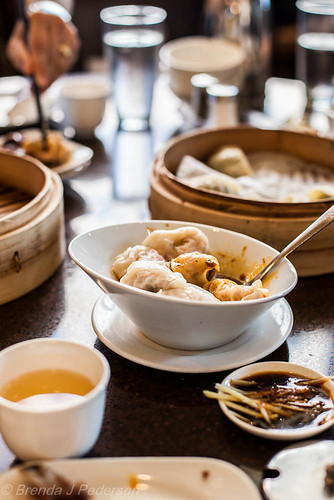
For one reason or another my first three attempts to check out Din Tai Fung fell through. On Saturday morning five of us finally had a succesful outing to this super popular dumpling house located in Bellevue. We’d heard wait lines for a table were often long so we arrived right at the 10:00 a.m. opening time. There were only half a dozen other groups already in line so we had no trouble being seated immediately but soon after the entire restaurant was filled. And that is saying something as the place is huge!
If you do have to wait, watch the cooks in the dumpling-making station through windows surrounding their area. A couple of people are cutting and weighing the dumpling dough, while (many!) others roll them out and fill them. It’s a fascinating production process.

Happy Hour at Local 360

The day we visited Local 360 the sun was shining brightly bringing hopes that spring would soon turn to summer. We were a little bummed that all the outdoor tables were full but relieved we weren’t outside when, about half way through our meal, a huge rainstorm swept the city, as often happens with unstable spring weather. From our bar stool perches we were able to watch the rain through the large windows behind the bar, keeping dry and leisurely finishing our meal.

Oatmeal Raisin Cookies
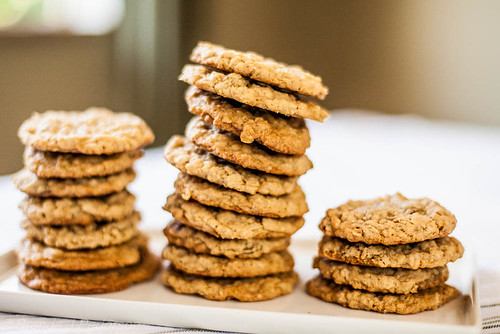
I purchased The Grand Central Baking Book
What I really love is that the recipes are perfectly tested and easy to follow. The only thing I do differently is make the cookies smaller than the recipes specify. Most of the recipes make large, bakery size cookies. I prefer cookies a little smaller. That way when I eat two of them I don’t have to feel so guilty! Making the cookies smaller affects the baking time but since ovens vary that can be the case with any recipe.
When making drop cookies you can use an ice-cream scoop to quickly and easily get your dough on the cookie tray. The recipe calls for big cookies that are about 1.5 ounces, which would be a #20 scoop size. I used a #40 scoop, which is about half that size. For information on scoop sizes and numbers see this handy page.
This recipe is great as is, although I may make a few changes such as adding cinnamon or using regular raisins instead of golden for a little color contrast. Dried cherries or little pieces of dried apricot would also be good in this recipe.
Read more…
LloydMartin

When Bricco on Queen Anne closed late last year it was disappointing. It really seemed like a perfect dining and gathering spot for the neighborhood and a place I enjoyed visiting. As it was closing there were already announcements that a new restaurant would be taking its place. I was glad to hear that the spot would be filled – I didn’t want to see gaps in the storefronts in that section of Queen Anne. LloydMartin is the restaurant that moved into the spot last fall. While they may have made changes to the interior before opening – I’m not sure – it feels the same to me. It’s a small space and without a complete renovation it would be hard to change the layout substantially.
A friend and I popped in a couple of days ago. It was another rainy, dreary June day and I had to run the few feet from my car to the door to escape the deluge. Once inside, the warm ambiance and friendly faces made me forget the ugly weather. For good measure I opted to start with their version of a Manhattan – I figured the whiskey would have its own warming effect. It was a good choice.
LloydMartin has a small happy hour menu, which they call Social Hour. I like that alternate name. It’s available from 5:00 pm, when they open, until 6:00 pm. There are both food and drink specials. I believe they change it along with the regular menu, based on what’s in season. We ordered both from both the Social Hour and main menus.
Read more…
Li’l Woody’s

A few weeks ago I was on Capitol Hill at lunch time and decided to check out Li’l Woody’s, a newish hamburger joint that’s had a lot of good press. Li’l Woody’s sits in that funky little section of Pine Street between the freeway and Melrose. Once you know it’s there it’s easy to see. The nice thing about the location is parking is a little easier than many places on Capitol Hill.
Li’l Woody’s logo is a Sasquatch and the interior of the place would make Big Foot feel at home. It’s a little bit rough with lots of wood – both finished and unfinished – but comfortable chairs surround the tables around the perimeter. And there are some fun touches like the old Coke coolers that hold sodas, juice and water.
Even better than the furniture though, are the ingredients. I’m originally from Oregon and any place that uses Tillamook Cheddar on their cheeseburgers has a big advantage with me! Plus the specialty burgers are full of creative and innovative combinations like Boat Street pickled figs and bacon or Hatch green chilis and queso sauce. And…. they serve Molly Moon milkshakes! Fries are hand-cut – something that can be hard to find.
For my initial visit I tried the Li’l Woody burger, the small size of their basic cheeseburger. While I was tempted by many of the specialty burgers I always like to start with a classic so I can get a real feel for the underlying burger. The Li’l Woody did not disappoint; it was everything a good cheeseburger should be – especially with that Tillamook Cheddar! The hamburger was delicious and the onions and lettuce provided a fresh, crunchy taste and texture without overpowering the meat. Although I wasn’t crazy about the fries, I know that many people will be. It’s a question of style not quality. If they were just a tad bit thicker there would be a little more potato taste and I would be perfectly happy. In some ways this will make it easier for me next time I’m in – housemade onion rings will be my side of choice. Having said that I may need to try those fries one more time, at least. There is a menu item called Crack, which is fries with a Molly Moon shake “dip”. That takes me right back to my days at Oregon State University where I spent many an afternoon with friends in the Memorial Union cafeteria munching on fries dipped in soft-serve ice cream. (How did they know?)
Read more…
Strawberry Jam

Last weekend I had my family over for a Father’s Day celebration. I made strawberry shortcake for dessert, using fresh strawberries from the farmers’ market. I had about a quart of sliced strawberries remaining even after eating another bowlful for breakfast on Monday morning. It was time to make a small batch of jam!
I used David Lebovitz’ recipe for “no-recipe cherry jam” substituting the strawberries for cherries. I really like this recipe because you can use whatever amount of fruit you have and then adjust the sugar and lemon juice accordingly.
With strawberries you can skip the first round of cooking since sliced strawberries are soft from the start. Be patient after you’ve added the sugar and cook until you’re sure your jam has jelled. I always get anxious with this step. Although, if you don’t cook it long enough, the worst that can happen is that instead of jam you end up with sauce or syrup – not the end of the world.
Asparagus Salad

A few weeks ago I friend and I had lunch at Le Pichet. They were featuring an asparagus salad that screamed spring. It was just a few simple ingredients but a great combination of tastes and textures. A few nights later I decided to replicate it for a dinner with friends. While mine was not exactly the same, it was close enough and just as delicious.
While fresh, local asparagus are still available give this one a try. All measurements are approximate – adjust to your liking.
Quinoa Tabbouleh

I’ve recently been on a quest to incorporate more grains into my diet. There are many interesting varieties available and several of them have significant health benefits. The June issue of Bon Appétit magazine had an article featuring salad recipes based on grains. I’ll be making all of them at some point but the Quinoa Tabbouleh seemed perfect as a side dish for a barbeque I hosted this past weekend.
Quinoa (pronounced keen-wah) is not actually a grain but a seed, but I’m not going to split hairs if you don’t! It has a lot of protein and fiber and is also a good source of iron. It’s also very quick to make. You can find packages of it in the grocery store, generally with the dried beans and rice or in the bulk foods section.
Tabbouleh is a refreshing Middle-Eastern salad that is usually made with bulgur. Traditional versions (I’ve heard…) generally use bulgur as more of a garnish than a primary ingredient. Most recipes you’ll find, though, use bulgur as the main ingredient enhanced with vegetables and herbs. This recipe follows that practice, substituting quinoa for the bulgur.
I followed the recipe pretty much as was in the article. I needed a large amount so I doubled most of the ingredients but used the single recipe amount of parsley and mint, as a couple of my guests are not crazy about flat-leaf parsley and I wanted to keep the mint to parsley ratio the same. I also used more lemon juice in the dressing. Other than that, this is one of those recipes that can easily be customized based on your preferences. I’ve added a few other notes in italics in the recipe.
The Coterie Room

After leaving Seattle for the sunnier, warmer climate of Los Angeles about a year ago my friend Megan recently returned for a visit. Megan and I met through our blogs many years ago. She is the face (or force!) behind I♥Bacon.com. And when my cooking club lost one of the original members it was Megan who moved into the open spot which she then filled for about 5 years.
With this history, you might guess that food and dining are an important part of our friendship. So when she returned to Seattle I sent her a list of new, or at least new-to-her, restaurants in town so she could select a location for a dinner reunion. Her choice? The Coterie Room.
I approached the evening’s dinner with a little bit of trepidation. While I love McCracken & Tough’s style and innovative creations, I’ve sometimes found the menu at Spur, their first location, a little precious. As an example a mid-summer cheese plate once featured peaches as one of the accompaniments. It was the perfect time of year for sweet, drippingly juicy, peaches in our area – I couldn’t wait. When the plate arrived the cheese portions were very generous but there were only three very small “peach balls” gracing the plate. They were very cute. And very disappointing. Then again, the cocktails at Tavern Law, their Capitol Hill speakeasy, never fail to please. So, to The Coterie Room we went and it turns out I had nothing to worry about. At all….
Syncline Rosé at Seatown Seabar

This weekend the Taste Washington event is in town and that means so are many winemakers. Even if you don’t attend the event, you have opportunities to meet them at many of the local wine shops and restaurants. Friday night one of my favorite wineries, Syncline, brought their newly released rosé to the patio at Seatown Seabar.
If you remember, Friday was another one of those pouring-rain days we’ve been having. And, the wind was whipping like crazy! But just as they cracked the little keg of rosé the sun broke through the clouds and warmed the patio. Somehow, the patio was also blocked from the wind, although I would not have suspected that. While it was still chilly, we sat in a warm pool of sunshine and I could imagine true spring days ahead. Then again, that could have been the rosé effect!


 Culinary Fool